Your Running Form Is a Skill. Here Is How We Train It Over 12 to 16 Weeks with 3D Gait Analysis
Emily Hill, DPT | RunDNA-Certified Running Specialist, Atomic PT

Most runners in Boulder train their engine and ignore their mechanics. You log the miles, hit the intervals, build the aerobic base. But how you actually move, the pattern your body repeats thousands of times per run, usually goes unexamined and unchanged for years. That is the missing piece, and it is trainable.
3D gait analysis shows us exactly what your pattern is doing. Neuromuscular re-education is how we change it. Here is what that process is, why it takes a full training block, and what it does for your running.
What neuromuscular re-education actually means
Strip the jargon and it is simple: teaching your nervous system a new way to move, through focused repetition, until the new pattern becomes automatic. Running form is not a single position you can cue once and fix. It is a fast, coordinated motor skill. Changing it works the same way any motor skill changes, whether that is a golf swing or a musical instrument. You practice the new pattern deliberately, it feels awkward at first, and over many repetitions your nervous system rewires it into something you can do without thinking. The 3D gait evaluation is what makes this precise. Instead of guessing at your form or copying a cue you saw online, we measure what your body is actually doing, identify the specific pattern worth changing, and match the retraining to you. Then the re-education does the real work over time.
Why it takes 12 to 16 weeks
This is the part most people underestimate. A new movement pattern is not a switch you flip. It is a skill you build. Programs that successfully change running mechanics run over multiple sessions across several weeks. The feedback is gradually reduced so you learn to hold the new pattern on your own (Crowell and Davis, 2011). The changes can take hold in the short term, but making a new pattern durable, so it survives fatigue late in a long run and holds up months later, takes more practice than a single visit can deliver. That is why we build this as a program, not a one-off appointment. A 12 to 16 week block gives your nervous system the runway to actually commit to the change. It also lines up with how most runners plan, one training cycle toward a goal race, which is the ideal window to do this work. The one thing you do not want is to start a form change during your taper, when there is no time left to make it automatic before race day.
Curious what your running pattern is doing? Start with a free 15-minute discovery visit. Dr. Emily Hill will talk through your running and goals and figure out whether a 3D analysis and a training block is the right move for you. Book your free discovery visit
What it does for injury risk
Running is hard on the body, and a large share of runners deal with an overuse injury in any given year. A meaningful part of that risk lives in how you load your body on each step, which is exactly what re-education can change. The best-supported lever here is cadence. Increasing your step rate by roughly 5 to 10 percent has been shown to lower the loading rate through your lower leg, which is one of the mechanical factors linked to overuse injury. Beyond the mechanics, some studies have connected gait retraining to lower injury rates over a full year, including work in newer runners suggesting a substantial reduction in injury risk.
What it does for performance
What actually drives performance in this program are three things working together:
Efficiency through better mechanics. A pattern that brakes less and wastes less motion is a more efficient pattern. This is the logical, mechanical case, and it is part of why we clean up form during your assessment.
Strength. This is the performance workhorse. Adding structured strength work, particularly heavier lifting and plyometrics, has been shown to improve running economy, meaning you use less energy at a given pace. Some studies report improvements of around 4 percent or more at race-relevant speeds. Strength also helps you hold your form and your pace late in a race when fatigue sets in.
Consistency. This is the one nobody markets and it might matter most. The biggest driver of long-term running performance is stringing together consistent, uninterrupted training. Injuries are the main thing that breaks that chain. Stay healthy, train consistently, and you get faster. That is the quiet engine underneath everything above.
Put together: better mechanics for efficiency and durability, strength for economy and late-race power, and staying healthy so you can actually train. That is a performance case that holds up and why Atomic PT is different than your typical physical therapy clinic.
How our programs work
Every runner starts the same way, with a 90-minute 3D evaluation in our performance lab our of Rocky Mountain Regenerative Medicine. We capture your gait, break it down through the full stride, identify your pattern, and give you a take-home report and a drills program matched to what we find. From there, the block is built around you. Depending on your goals and whether you are managing any injuries, it layers in gait follow-up sessions to refine and progress the retraining, hands-on physical therapy where it is needed, and a strength program built for your running. We treat it like strength and conditioning for your run, progressed over the 12 to 16 weeks so the changes are still there when you need them on race day. You are not handed a printout and sent off. You are coached through the change until it holds.
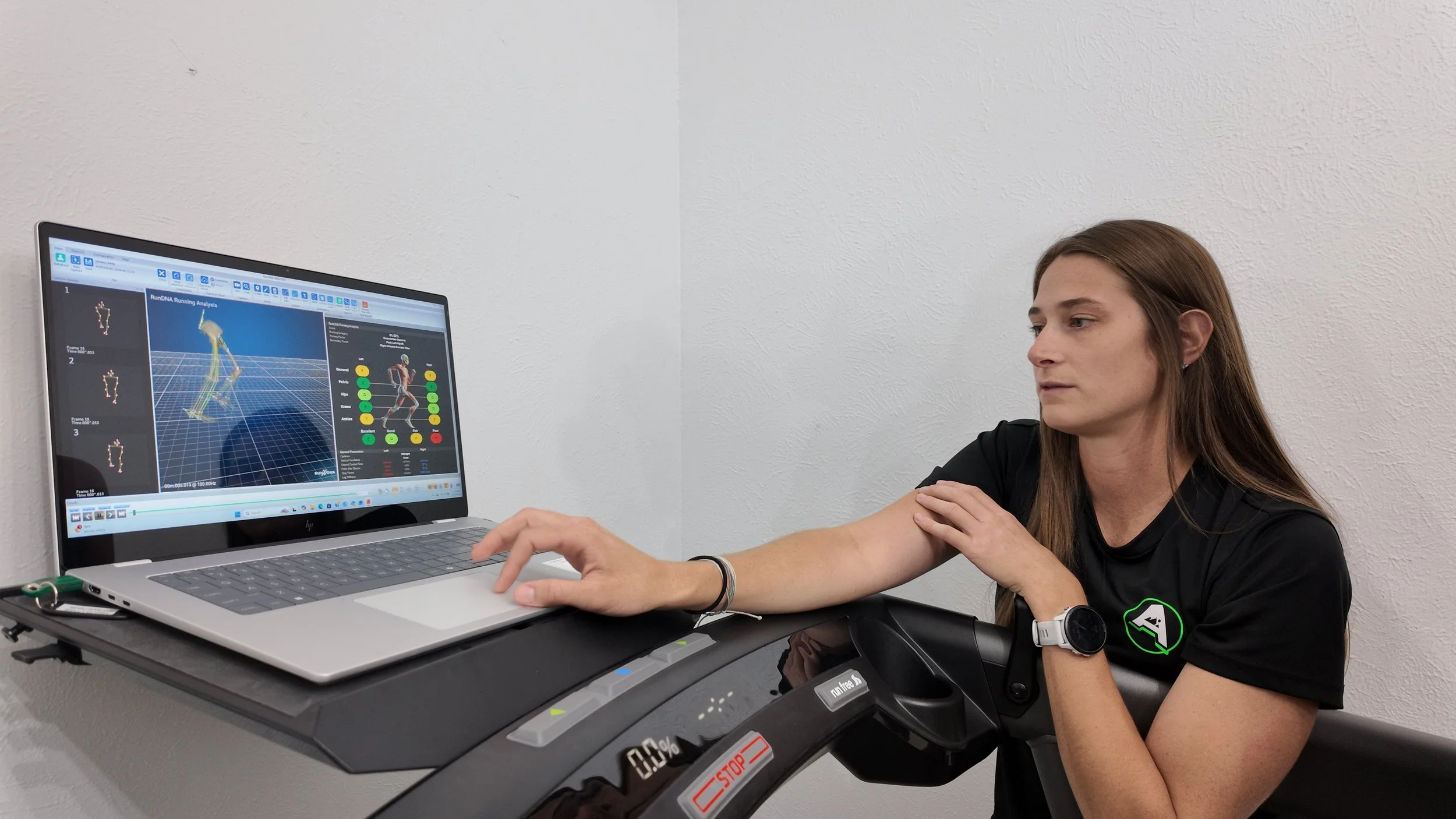
Dr. Emily Hill reviewing a patients’ 3D Running Gait Analysis in session
When to start
If you have a goal race, count back 12 to 16 weeks and start there. That gives the re-education time to become automatic and the strength work time to build, all before your taper. If you do not have a race on the calendar, the start of any training cycle is a good time. The worst time is late, when there is no runway left to make a change stick.
Got a goal race or a training block coming up? Let's build the runway to get there faster and healthier. Book a free 15-minute discovery visit and we will map out the right plan for you. Book your free discovery visit
Emily Hill, DPT, is a RunDNA-certified running specialist at Atomic PT in Boulder, Colorado.
Why This is Programming and Not a One-and-Done
The reason timing matters so much comes back to how form change actually works.
In one well-known program, runners used real-time feedback across roughly eight sessions over about two weeks to meaningfully reduce impact loading, with those changes holding in the short term (Crowell and Davis, 2011). What longer-term follow-up work suggests is just as useful to know: the new pattern is not always automatic months down the road, and it often needs continued practice to stick.
That is the whole case for treating gait work as ongoing programming rather than a single appointment. We build it like strength and conditioning for your run, with a plan you practice over time, so the change is still there when you need it on race day.
A few special cases for 3D gait analysis
Coming back from injury before a goal race. Get analyzed early. Returning to running without checking whether your movement pattern changed during time off is one of the more common ways to re-injure. The earlier we see it, the more we can do about it.
Your first goal race. Earlier is better. Build the habits from the start rather than trying to unwind them later.
A big mileage jump. If you are ramping volume significantly, your form under fatigue is worth understanding before the miles pile up, not after something starts to hurt.
Baseline metrics. You are healthy and performing at your best so you want to document this gait pattern now so you can come back and compare it to any issues down the road.
Bottom line
A gait analysis is one of the most useful things a runner can do before a race to improve performance. Just give it enough runway to actually help. If you want to change how you run, plan it for early in your training. If you just want a look, you have more room. When in doubt, ask early. The worst timing is realizing you needed it during your taper.