Why the Outside of Your Knee Hurts When You Run (And Why Stretching Your IT Band Won't Fix It)
Emily Hill, DPT | RunDNA-Certified Running Specialist, Atomic PT
It shows up a few miles in. A sharp, specific pain on the outside of your knee. It gets worse going downhill. You stop, it fades, you start again, it comes back. You have been rolling your IT band on a foam roller for weeks and it has not changed anything.
IT band syndrome is one of the most common causes of lateral knee pain in runners, and it is one of the most misunderstood. The name points you at the wrong place. The problem is rarely in the band itself.
Your IT band is not tight. It is not the problem.
The iliotibial band is a thick sheet of connective tissue running down the outside of your thigh from your hip to just below your knee. It is extremely strong and it does not lengthen meaningfully with stretching or rolling. If foam rolling gives you temporary relief, that is a nervous system effect, not a structural change.
The older explanation was that the band rubbed back and forth over the bone at the outside of your knee and got irritated. More recent thinking has moved toward compression instead: the band is pulled tight against the tissue underneath it, and that tissue is sensitive. That distinction matters because it changes what you do about it. You cannot loosen a compression problem by stretching the thing doing the compressing. You have to change the forces pulling it tight.
Those forces come from your hip and your stride
The tension on your IT band is not generated at the knee. It is generated by what your hip and pelvis are doing at the moment your foot hits the ground.
Three patterns come up repeatedly in runners with this problem. Your pelvis drops on the opposite side during stance. Your knee falls inward relative to your hip and foot. Your feet land closer to the midline than they should, sometimes crossing over it, which is often called a cross-over gait.
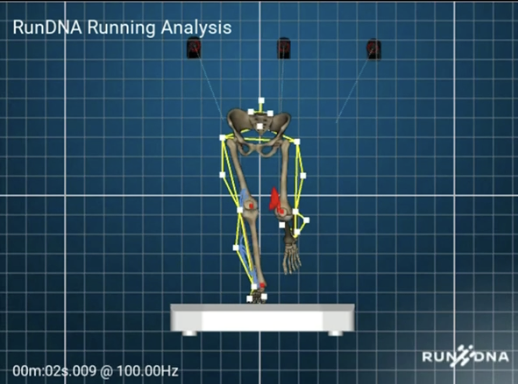
This is a view looking straight on using our new 3D camera. Note the drop of the left pelvis with the right leg in stance phase. This is an example of hip drop and a large contributor to IT Band Syndrome.
Why Boulder runners get this more than most
The pain classically worsens on descents, and Boulder is a town built on descents. If you run Boulder Valley Ranch, Sanitas, or anything off the Mesa Trail, you spend real time coming downhill. Downhill running increases the eccentric load your hip and quad have to absorb on every step and keeps your knee in the range where the band is under the most compression. Add the mileage most people here run and it stacks up fast.
Here is the actual problem with figuring this out on your own
Every mechanism above happens in the frontal and transverse planes. Pelvic drop, knee collapse, hip rotation, foot placement relative to your center of mass. None of it is visible from the side, and none of it is measurable from a phone video. You can film yourself running and see a heel strike. You cannot see how many degrees your pelvis drops, or whether it is worse on one side, or whether that gets worse when you fatigue.
That is why generic advice fails here. Strengthen your glutes is not wrong, but it is not a plan. You need to know which pattern is yours, how big it is, and which side.
Curious what your hip is actually doing when you run? Start with a free 15-minute discovery visit. We will talk through your pain, your training, and whether a 3D gait analysis makes sense as a next step. Book your free discovery visit with Dr. Emily Hill, Running Specialist.
What we do instead
We measure it. A 3D gait analysis at Atomic captures your body in all three planes and turns it into numbers: hip adduction, pelvic drop, knee position, foot placement, cadence, and how each of those changes through the full stride cycle. Not an impression from watching you run. Data.
From there the plan is specific to what we found. Cadence is often the first lever, because increasing your step rate by a modest amount tends to shorten your stride, bring your foot closer under your body, and reduce the load going through the hip on each step. Strength work targets the specific deficit, not a generic glute circuit. And we retrain the pattern over a training block, because a movement change is a skill, and skills take repetition to hold up under fatigue.
If you are dealing with this right now
Rest will calm it down. It will not change the mechanics that caused it, which is why it comes back the moment you rebuild mileage. If you have been managing this for more than a few weeks, or it has come back more than once, it is worth finding out what your stride is actually doing.
Book a free 15-minute discovery visit and we will figure out the right starting point together.
Emily Hill, DPT, is a RunDNA-certified running specialist at Atomic PT in Boulder, Colorado.