The most complete marathon build we write. Structured doubles, weekly threshold work, and the load management needed to hold 87 to 95 miles together. Drawn directly from real Atomic Race Team training blocks.
Full description
At this volume, the question is no longer whether you are training hard enough. It is whether you are actually absorbing the training you are already doing. That is the problem this guide is built around. Doubles are structured rather than simply added, with clear guidance on where to place the second run and what it is meant to accomplish. Two quality sessions each week sit alongside dedicated LT1 work, and the guide shows exactly how hard days, threshold work, and long runs fit together across a week that can reach 90 miles. Deloads are treated as part of the training, not time away from it. They are where you absorb the work that came before so you can handle what comes next.
The sessions come from blocks our own race team has actually run, with every workout written out with paces, recoveries, and intent. Benchmark workouts repeat at four points throughout the program, giving you an objective way to track your fitness through your own splits rather than relying on how you happen to feel on a given day.
The guide covers heat acclimatization, strides, race-week logistics, carbohydrate loading, gut training, and a pacing strategy built around your own numbers rather than an arbitrary target time. Strength and injury guidance comes from physical therapists who treat competitive runners every week. At 90 miles per week, keeping your body healthy is not an optional add-on. It is part of the training.
The block at a glance
18 weeks including taper and race week. Six to seven days of running, with up to nine sessions through structured doubles. Peak mileage of 87 to 95 miles per week, with long runs reaching 23 to 25 miles.
One honest note: this tier only works if the mileage gets run. If the volume does not fit your week, Advanced will produce a faster race than an Elite plan you cannot consistently complete.
Where these sessions come from
The Atomic Race Team is a group of competitive athletes training out of Boulder. Between them are Boston qualifiers, elite women training at the US Olympic Trials standard, sub-75-minute half marathoners, Bolder Boulder top-five finishers, and athletes competing at USATF Championships. This program is not built from a generic marathon template. It mirrors the training our athletes run.
Also inside
Pace charts in miles and kilometers, heart-rate and effort zones, a printable training log, and an online tracker pre-filled with every run.
The most complete marathon build we write. Structured doubles, weekly threshold work, and the load management needed to hold 87 to 95 miles together. Drawn directly from real Atomic Race Team training blocks.
Full description
At this volume, the question is no longer whether you are training hard enough. It is whether you are actually absorbing the training you are already doing. That is the problem this guide is built around. Doubles are structured rather than simply added, with clear guidance on where to place the second run and what it is meant to accomplish. Two quality sessions each week sit alongside dedicated LT1 work, and the guide shows exactly how hard days, threshold work, and long runs fit together across a week that can reach 90 miles. Deloads are treated as part of the training, not time away from it. They are where you absorb the work that came before so you can handle what comes next.
The sessions come from blocks our own race team has actually run, with every workout written out with paces, recoveries, and intent. Benchmark workouts repeat at four points throughout the program, giving you an objective way to track your fitness through your own splits rather than relying on how you happen to feel on a given day.
The guide covers heat acclimatization, strides, race-week logistics, carbohydrate loading, gut training, and a pacing strategy built around your own numbers rather than an arbitrary target time. Strength and injury guidance comes from physical therapists who treat competitive runners every week. At 90 miles per week, keeping your body healthy is not an optional add-on. It is part of the training.
The block at a glance
18 weeks including taper and race week. Six to seven days of running, with up to nine sessions through structured doubles. Peak mileage of 87 to 95 miles per week, with long runs reaching 23 to 25 miles.
One honest note: this tier only works if the mileage gets run. If the volume does not fit your week, Advanced will produce a faster race than an Elite plan you cannot consistently complete.
Where these sessions come from
The Atomic Race Team is a group of competitive athletes training out of Boulder. Between them are Boston qualifiers, elite women training at the US Olympic Trials standard, sub-75-minute half marathoners, Bolder Boulder top-five finishers, and athletes competing at USATF Championships. This program is not built from a generic marathon template. It mirrors the training our athletes run.
Also inside
Pace charts in miles and kilometers, heart-rate and effort zones, a printable training log, and an online tracker pre-filled with every run.

 Image 1 of 7
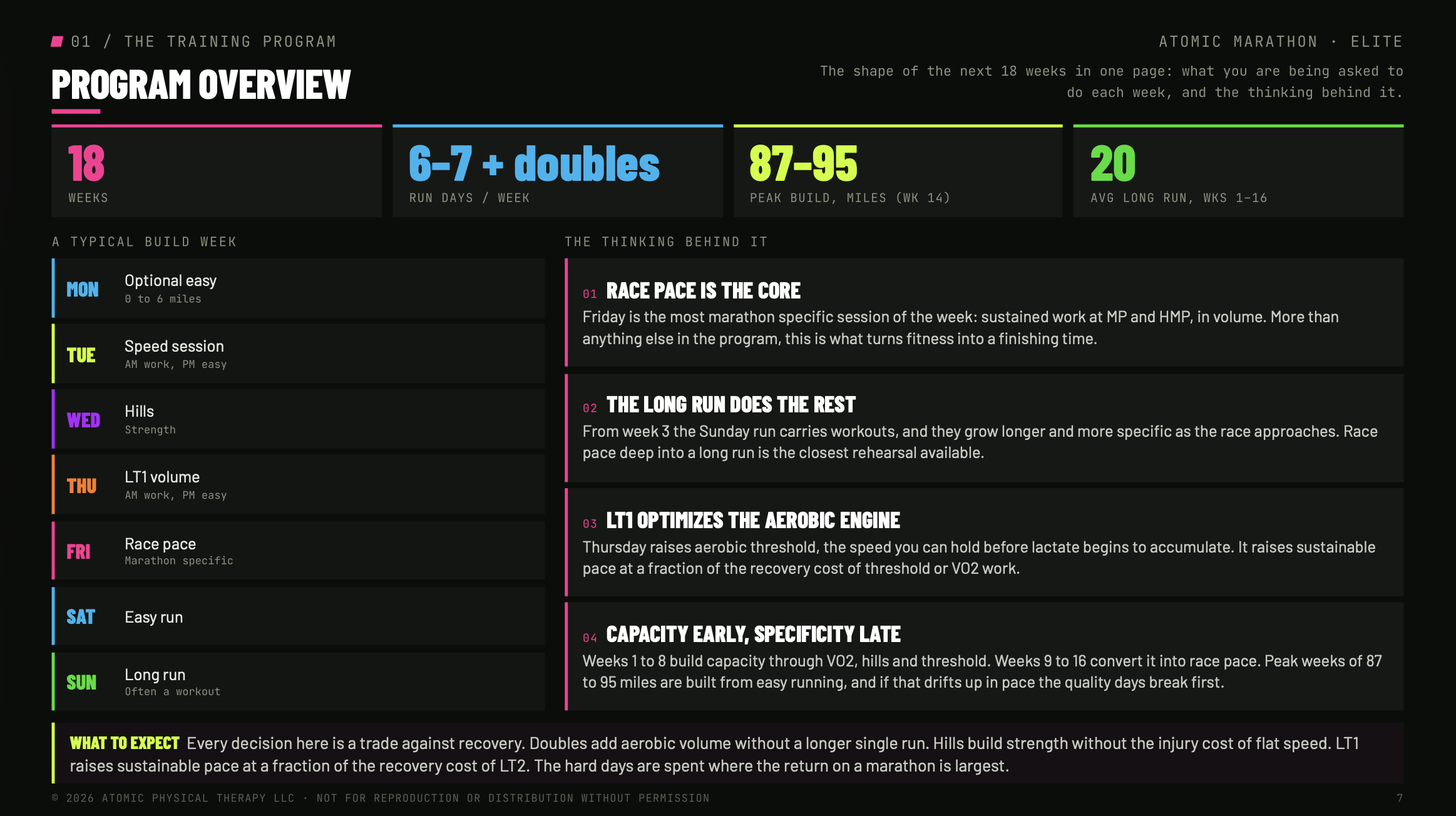 Image 2 of 7
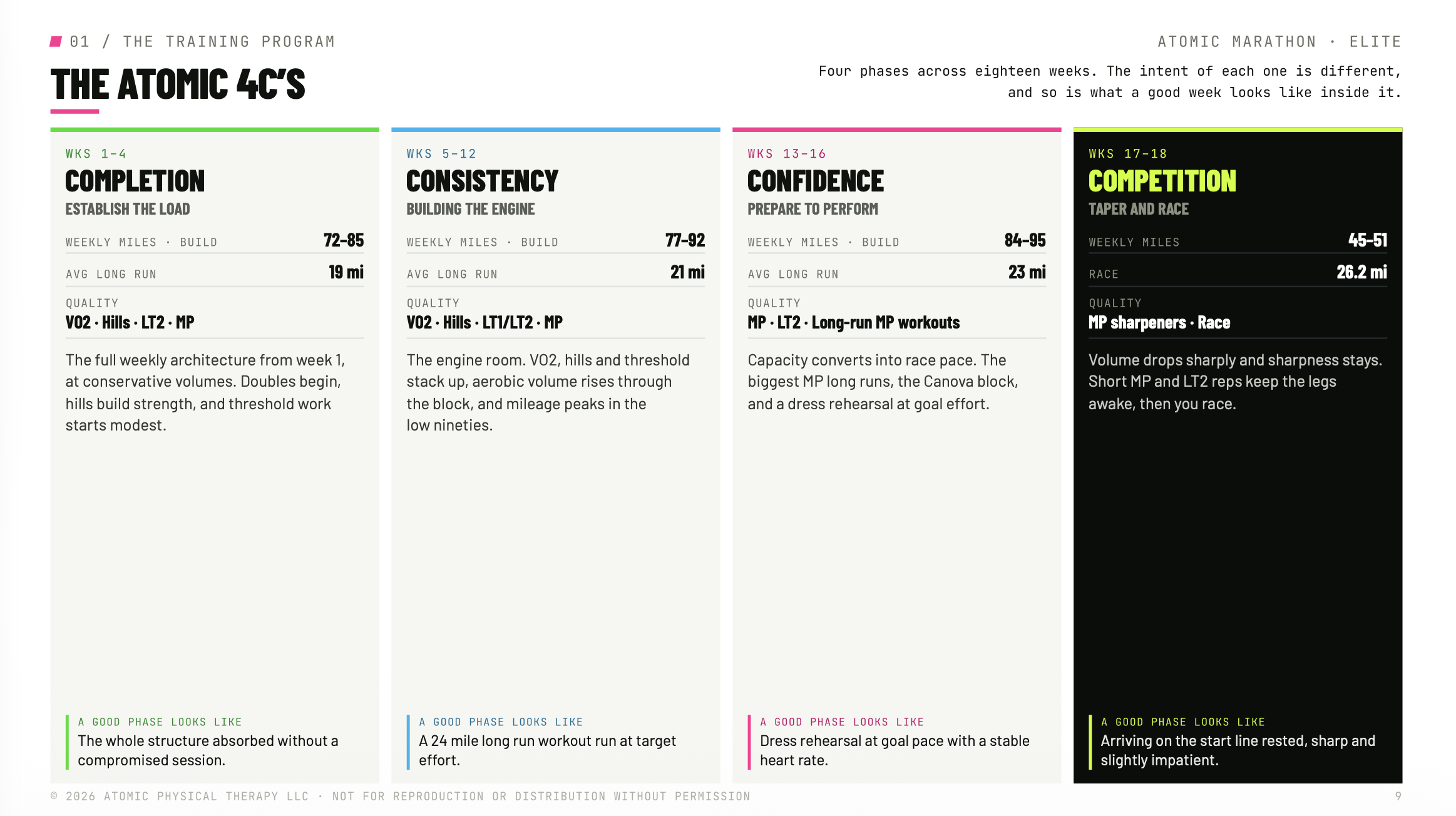 Image 3 of 7
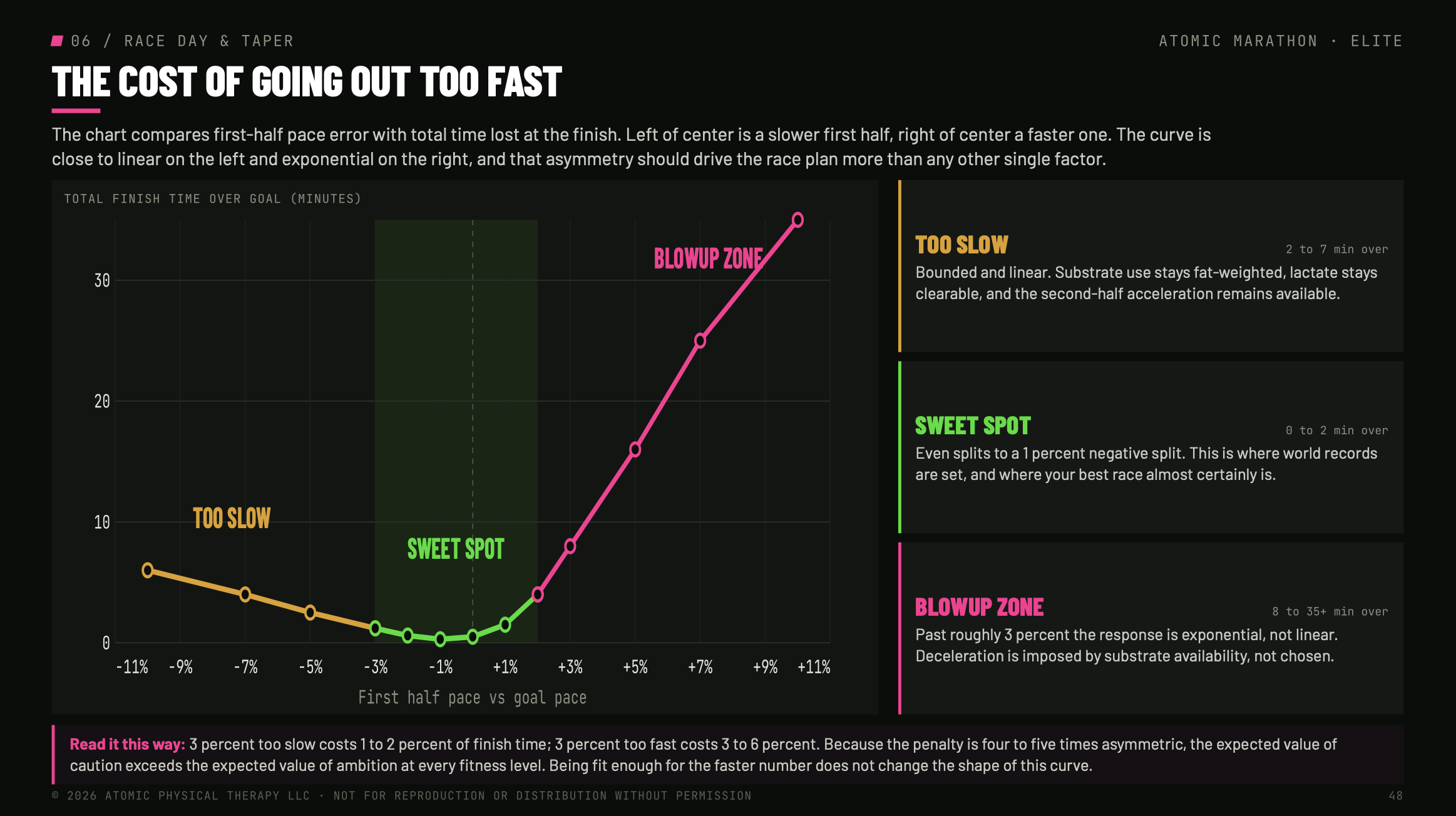 Image 4 of 7
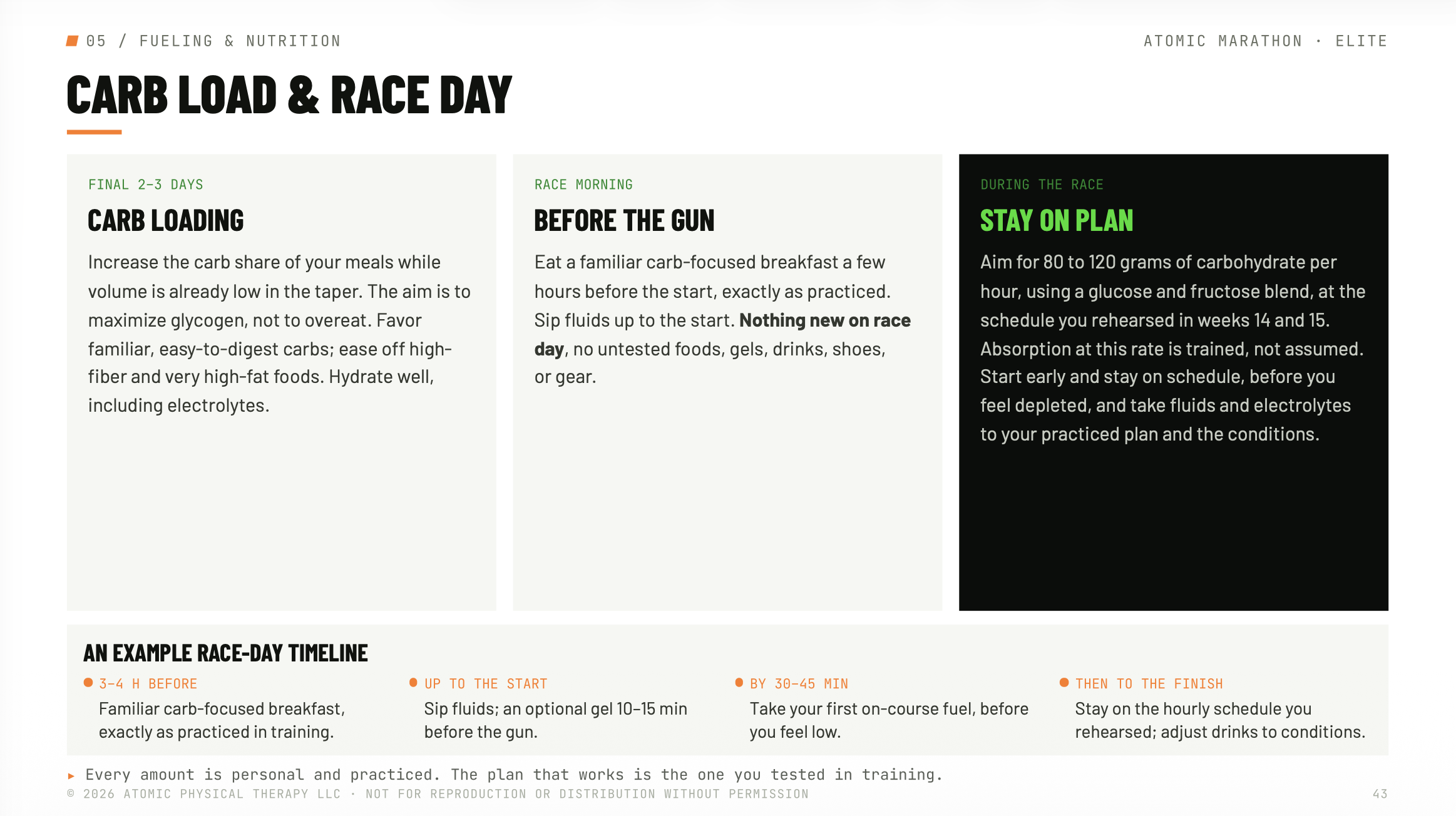 Image 5 of 7
 Image 6 of 7
 Image 7 of 7